
First Thoughts
Gay Affirmative Therapy is a product of our time. It is a description of practices which arises out of the context of a dominant culture in society which attempts to regulate and specify according to normative notions of gender and sexuality. It arises out of a discourse of power which asks questions about how operations of power have been and are carried out. The more local domains of psychology and therapy can boast a history of subjugation and oppression in the treatment of lesbians, gay men and bisexuals.
Our premise in this paper is that gay affirmative therapy is an indication of a discourse in transition - both within and without of psychology and psychotherapy - and that we should be looking to how gay affirmative practices might be thought of within a practice of critical therapy. Critical Therapy encourages an idea of a constantly evolving relationship between theory and practice and which recognises the influences on our thinking of different contexts such as race, culture, class, gender and sexuality.
Practice Context
The ideas we are presenting in this paper are significantly influenced by our experience in setting up and running a counselling and psychotherapy practice for lesbians, gay men and bisexuals in London. Our clients approach us assuming or knowing that all the therapists in the practice are lesbian, gay or bisexual. We work with individuals, couples and families - only a small proportion of whom specifically seek consultations because they are uncomfortable about being gay.
Theoretical Context
We are particularly interested in Social Constructionist and Systemic theories as described by Cronen & Pearce (1980, 1989, 1994), Gergen et al (1992), Shotter et al (1989), Cecchin et al (1993), White (1989, 1991) in which
- Social context is foregrounded over a notion of an individual's internal world. There is a shift from "knowledge" to ethics.
- Human beings are seen as meaning-generating.
- There is a concern with the relationship between meanings and actions and the social contexts within which these arise.
- Meaning depends on context. We act out of and into contexts.
- Identity is continually being co-constructed in different contexts.
- Language is seen as expressing and constructing our experience. We make sense of our experience through the descriptions available to us.
- Therapy is a context for the collaborative deconstructing and co-creating of meaning.
"Descriptions and explanations of the world are themselves forms of social action and have consequences. Different descriptions and explanations have different consequences." (Gergen 1985)
Theories as Stories
The Virtual Library of Queer Stories has neither been fully read nor yet written. Let alone acted on. Our stories, as lesbians and as gay men, as bisexuals and as third gendered people, have barely started to be told or lived. What we work with in "therapy" is, by and large, a set of stories which we call "theories" which come out of stables rarely frequented by queers except in role as "patients". Gay affirmative therapists see themselves more as "impatients", expecting change: change in the valuing and presence of stories which are not usually found on the shelves of therapeutic or societal discourse; change in the attitude to therapeutic/psychological "knowledge".
Most psychological theories have, in the modernist past of scientific "realities", subscribed to an idea of revealing the truth of about a subject, uncovering "knowledge" from which general principles could be deduced and applied to the world at large. Psychotherapy has, and in many instances, still does, participate in this discourse of finding out what is "really" going on with a client. Our attitude to "knowledge" and "truth" is changing. We are beginning to appreciate how subjective "the facts" usually are. What we take to be the case is the consequence of the ways we have available to make sense of the world.
Foucault (1976 ) said "The history of sexuality must first be written from the view point of a history of discourses." Stories about sexuality are best understood as arising out of socio-historical contexts. Sexuality is a concept which, therefore, has shifting meanings. Given its centrality in our culture, the descriptions we are invited to take on and expected to perform about our sexuality or an aspect of our identity, say a lot about who we are and our adequacy in the world. Those stories act as ways of defining and regulating social behaviour often, for example, by disqualifying different practices. Pathologising is one form of disqualifying.
Power, gender and sexuality are interrelated discourses. It is not surprising, therefore, that ethical questions have arisen for counsellors and psychotherapists concerned with the practices of power both within therapeutic practice and in society at large. We feel it is important to be mindful of the interplay between the power relations in society and those practised in therapy. The question of Gay Affirmative Therapy seems to arise out of this concern which calls into question dominant stories about sexuality, the performance of gender, the individual and therapy.
Thinking about Gay Affirmative Therapy: Language and Practice.
The term "Gay Affirmative Therapy" has tended to come from a North American person-centred discourse. Davies (1995) suggests that the word "gay", has most often been used in "gay affirmative therapy" as a generic reference to gay men, bisexuals and lesbians and that the gay affirmative therapist "affirms a lesbian or gay identity as a positive thing, without necessarily pushing anyone towards it."
As well as recognising gay affirmative therapy which has some usefulness as a description of a problem in the therapeutic discourse and may propose some ways forward, there are certain questions which arise for practitioners from different psychological discourses.
1) For some therapists there might be an idea implicit in the notion of affirmative therapy which can sometimes sound as if what is being affirmed is intrinsic to the person, fixed and an essential part of their "being", who they really are. The Oxford English Dictionary gives several meanings of affirmative: agreement, favouring, approving and asserting that a thing is so. We would tend to regard a person's identity as fluid and co-constructed. Otherwise we might participate in specifying and categorising sexuality further.
2) The therapist is seen as having the authority to recognise and validate the experiences of their client. We feel this raises an important question about the understanding of the relationship between client and therapist. It might create an idea that the therapist is in a better position to empower or affirm the client's experience than the client (Amundson, Stewart & Valentine 1993). We suggest that a description of co-constructive practice may well fit better for many therapists and, in turn, may shift some of the power dynamics with which they feel to be incoherent with their ideology.
3) It seems that the word "affirmation" is being used in the context of this conference to describe an attitude of the therapist supported by therapeutic actions. What kinds of beliefs are behind this attitude? Is it always best to be affirmative of a person's self description? When might the origins and consequences or context of this description need exploring further?
4) It does not necessarily take account of creating and developing meaning, for example, about "becoming" gay or lesbian. (Foucault 1981)
The Role of Language in Therapy
The activities we participate in as lesbians and gay men are constantly evolving and the accounts for these activities often taken longer to emerge in language than they do in practice. As they begin to appear in language, we wrestle with the meaning of activities - new and old - and look at them through mainly negative lenses which we have inherited and which were invented by non-participants. How helpful then are the concepts of healthy and unhealthy? Under which column do we put sadomasochism currently?
In addition to any negative ideas which lesbians or gay men may have adopted, we find many people have also been recruited into a language of pathology way before they get to therapy. In fact, we find many clients feel it is expected of them to be able to explain their problems in problem-saturated, psychotechnical terms. " I am a co-dependent", "We have communication problems", "I come from a dysfunctional family". Inevitably, there is an undermining content to the description. Maybe it would be interesting to ask "If you had never come across psychology theories before, how do you think you would be describing your concerns to me?" or "How would you have described yourself/ behaviours before you came across that phrase?" It is likely that many people would still feel negatively about themselves. It seems that the language associated with therapy has been appropriated by members of the public to bring forth negative descriptions of themselves, emphasising their inabilities. (Those trained in counselling and therapy, in our experience, are often the most affected by this negative accounting). While admitting to what is problematic may be helpful and agentive(ref/explan) action, for many people, "therapy" has become associated with producing negative explanations and descriptions of the self and relationships.
From Fixed Descriptions to Emergent Abilities
Given the impossibility of neutrality for therapist and client (1), how can we ensure that we create the conditions for both to explore meanings and ideas behind clients' and our own experiences so we can free themselves of stories which act as constraints and develop accounts which allow for other possibilities and create stories of ability?
One option is to work with the client to deconstruct their negative accounts and ideas (White, M. 1991), looking at how these ideas have come about and how they work for or against the client and in which contexts. The following examples are not taken from any specific clients but the patterns of description are familiar.
Case Example 1
Client - I don't feel comfortable about the kind of sex I'm into.
Therapist - How come?
Client - It's just not normal.
Therapist - What gives you the idea it's not normal?
Client - Well, I've only ever met three others who, um, like, er, the kind of thing I like.
Therapist - How many people would you have to come across before you did think it was normal?
Client - Er, um, maybe fifteen. Ten?
Therapist - Fifteen to ten. How long has it taken to meet these three?
Client - Two years, bit less.
Therapist - Three in two years. That's another six to eight years of feeling abnormal. I wonder if, for a moment, you imagine that there is a discussion group running for people who practise the same things you do. There's about fifteen people present - all discussing what they like, have tried etc. How do you think that would affect your sense of not having normal sexual practices?
Client - I dunno. I think it would be a bit of a laugh. We could swap tips!
Therapist - How do you think you might be feeling if you thought your behaviour was closer to normal?
Client - Well, I wouldn't want it to be too normal. Could be a bit boring. I like the idea of there being lots and lots of others though.
Therapist - Could you get too comfortable with your SM practices?
Client - I don't think so. Maybe.
Case Example 2
Client - I am such a depressed and needy person.
Therapist - What gives you that idea?
Client - Oh, I've been feeling very down.
Therapist - About what?
Client - I think I'm worried about John finding out what I'm really like.
Therapist - How does he see you at the moment?
Client - He thinks I'm a happy and independent person.
Therapist - How do you think he gets that idea?
Client - I am happy when I'm with him.
Therapist - Only when you are with him?
Client - No. In fact, I've been happy a lot over the last few weeks.
Therapist - So, do you think he sees you as happy and independent because he is ignorant of the depressed parts of you? Or do you feel you have been acting happier and more independent than you have felt yourself to be?
Client - Well, he doesn't know me that well yet. (Pause) But I think I probably am happier than I realise and I forget that I am quite independent now. Because John has only come out quite recently, I can see how far I have come myself from the days when I was dealing with being gay and was so down.
Therapist - What difference do you think it makes to you when you think of yourself either as the depressed and needy person or as a happier and quite independent person?
Client - I tend to look on the bleak side of things.
Therapist - What? When you you think of yourself as depressed and needy? Or when you think of yourself as happy and independent?
Client - Hmm. Both. When I am feeling happier too.
Therapist - How do you think looking on the bleak side of things works for you or against you?
Client - I think I can't always see when things are going right. I just always assume the worst - in case I get disappointed. I can't bear disappointment.
Therapist - What do you mean by "disappointment"?
Client - Taking a fall, getting hurt. (Pause) But I guess getting hurt is just part of life really, isn't it.
Therapist - So, what difference do you think it would make, if any, if you thought of yourself as happier and quite independent?
Client - Hmm. I think I'd be less afraid of being hurt. And maybe, people wouldn't think they could mess me around as much.
Here the therapist is asking questions for the client to explore their own thinking. The clients start with a negative and fixed description of themselves or their practices and throughout the conversation they deconstruct this initial description, opening up space to for other descriptions and allow for other meanings to emerge. By taking an irreverent attitude (Cecchin et al 1993) to one's own and the client's descriptions of depression or of SM and by exercising a curiosity about the client's ideas, one can explore with the client how they think the different descriptions may act to constrain or liberate.
Critical Therapy: thinking about the Relationship between Theory and Practice
Critical therapy is useful to us in thinking about the thinking that shapes our practices in therapeutic contexts. It invites and encourages account-ability - how we account for our actions as therapists, how our accounts influence in turn what we notice and treat as meaningful, what we include and exclude. Weingarten (1992) proposes that it is important for a therapist that "he or she is constantly selecting aspects of the conversation to amplify or diminish..... that this process of selection is guided by a number of variables including the therapists experiences gained by virtue of being located in a particular racial, gendered and class position in the wider socio-political context within which therapy takes place."
Leppington (1991) proposes a way of thinking about practice by looking at the reflexive and recursive relationship between our epistemology (ways of thinking about what we think we know), theory, method and data (what we learn/ feedback).
This diagram demonstrates a relationship between these components which allows for change at any level, at any point in the therapeutic process. Each level acts as a context for the other.
Fig. 1 (Leppington 1991)
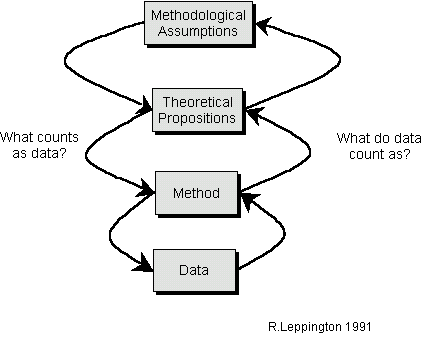
The level of methodology is influenced by our epistemology (our entire ways of seeing the world) to which we bring all kinds of stories and ideas from cultural, family and personal contexts. These influence our choice of theoretical approach which, in turn, influences what we do in the therapy in the way of techniques. Our technique will bring forth one kind of story or data rather than another.
To avoid confirming one's own basic premises or "becoming attached to one's own story", Leppington proposes taking an ironic stance in relation to the conversations which come about between therapist and client - we would call this critical positioning - in which one is
Evolving Thoughts.......
One of the problems then, with affirming a lesbian or gay identity or any aspect of identity for that matter, is that identity can be described as a fluid and emergent thing. Davies (1995) describes gay identity as being "a set of cultural beliefs, values and support networks which contribute to the modern lesbian or gay man." Perhaps the notion of gay identity and culture throws up further questions for the postmodern lesbian or gay man and it certainly raises questions for the postmodern lesbian, gay, bisexual and other concerned therapists who have rejected an idea of "true", fixed identity.
How do we as therapists create and use an awareness of the commonalities of lesbian and/or gay and/or bisexual experience while, at the same time, create the conditions to explore the meaning of descriptions which we might otherwise take for granted and create new accounts of what it means to be lesbian or gay?
Are gay affirmative practices something discreet which people can add on? Or do we need to develop a practice at a higher level which has built into it an invitation to think about ideologies and theories, which provides a way of speaking about therapeutic practices that can account for power, take account of power and recognise how power operates in the contexts of not only sexuality but also other arenas for oppression such as gender, race, class and ability?
It is our hope that, as lesbian, gay and bisexual and third gendered therapists, we will value and develop our ability to be curious about the influence of ideology on practice and co-create with clients and colleagues the ability to both participate in a discourse, be reflexive about our place in it and decide how we want to continue to participate in the future.
(1) Neutrality is generally a modernist concept based on the idea that there is such a thing as scientific objectivity (Bateson 1980). Systemic therapy suggests that all theories have a subjective context and that it is impossible for a therapist to free themselves of personal values (Weingarten 1992). The aim of a postmodernist therapist might be to practice self reflexivity (Hoffman 1990) and treat psychological theories as different narratives that may privilege certain ideas over others. (White 1991)
Amundson, J., Stewart, K. & Valentine, L. (1993) Temptations of Power and Certainty. Journal of Marital & Family Therapy 1993 Vol.19.2
Anderson, H. & Goolishian, H. (1988) Human Systems as Linguistic Systems: preliminary and evolving ideas about the implications for clinical theory. Family Process 27:4
Anderson, H. & Goolishian, H. (1993) The Client is the Expert: a Not-Knowing Approach to Therapy. Therapy as Social Construction. Eds. Mcnamee, S. & Gergen, K. Sage. UK
Bateson, G. (1973) Steps to an Ecology of Mind. Palladin, London.
Cecchin, G., Lane G., Ray W. (1993) From Strategising toNon-Intervention: Towards Irreverance in Systemic Practice. Journal of Marital & Family Therapy. 17.1
Cronen, V. & Pearce, W.B. (1980) Communication, Action and Meaning: The Creation of Social Realities. Praeger, New York
Epston, D. & White, M. (1992) Experience, Contradiction, Narrative and Imagination: Selected Writings of Epston and White. Dulwich Centre Publications. Australia.
Foucault, M. (1976) The History of Sexuality: An Introduction. Peregrine (reprint) 1984. UK
Foucault, M. (1981) Friendship as Lifestyle: An Interview. Gay Infromation. Vol.7 Spring 1981 (4)
Gergen, K. (1985) The Social Constructionist Movement in Modern Psychology. American Psychologist 40 pp 226-275
Gergen, K. & McNamee, S. (Eds.) (1993) Therapy as Social Construction. Sage. UK
Leppington, R. (1991) From Constructivism to Social Constructionism and Doing Critical Therapy. Human Systems: Journal of Systemic Consultation and Management. Vol.2.2
Pearce, W. B. (1989) Communication and the Human Condition. Southern Illinois University Press
Pearce, W. B. (1992) A Camper's Guide to Social Constructionisms.Human Systems: Journal of Systemic Consultation and Management. Vol.3 & 4.2
Pearce, W. B. (1994) Interpersonal Communication, Making Social Worlds. Harper Collins College Publishers. New York
Shotter, J. & Gergen K. (Eds.) (1989) Texts of Identity. Sage. London
Tomm, K. (1987-88) Interventive Interviewing: Part I: Strategizing as a Fourth Guideline for the Therapist. Family Process. 26: 3-13;
Tomm, K. (1987) Interventive Interviewing: Part II: Reflexive Questioning as a Means to Enable Self-Healing.. Family Process. 26: 167-183
Tomm, K. (1988) Interventive Interviewing: Part III: Intending to ask Lineal, Circular, Strategic or Reflexive Questions? Family Process. 27: 1-15
Weingarten, K. (1992) A Consideration of Intimate and Non-Intimate Interactions in Therapy. Family Process
White, M. (1988) Externalising the Problem. Dulwich Centre Newsletter
White, M. (1991) Deconstruction and Therapy in Experience, Contradiction, Narrative and Imagination: Selected Papers of David Epston and Michael White 1989 - 1991. Ed. Epston, D. & White, M. Dulwich Centre Publications. South Australia
Further Reading
Bannet E. Tavor (1993) Postcultural Theory: Critical Theory after the Marxist Paradigm. Macmillan
Carl, D. (1990) Counselling Same Sex Couples. Norton, London
Fuss, D. Ed.(1991) Inside/Out Lesbian Theories, Gay Theories. Routledge, New York
Hoffman, L.(1989) From System to Discourse. Human Systems: Journal of Systemic Consultation and Management. Vol.1
Hoffman, L.(1990) Constructing Realities: An Art of Lenses. Family Process 29; 1-12.
Kitzinger, C. (1989) The Social Construction of Lesbianism. Sage
Kvale S. (ed.) (1992) Psychology and Postmodernism. Sage.
Rosenau, P.M. (1992) Post-Modernism and the Social Sciences. Princeton Paperbacks.
Sarup M., (1993) An Introductory Guide to Poststructuralism and Postmodernism. Second Edition. Harvester Wheatsheaf.
Stacey, K. (1993) Exploring Stories of Lesbian Experience in Therapy: Implications for Therapists in a Postmodern World. Dulwich Centre Newsletter 1993 No.2 Adelaide
THE PRACTICE | HOW WE WORK | WHAT WE CAN HELP WITH | OUR PRACTITIONERS | CONTACT
ORGANISATIONS AND PROFESSIONALS | LINKS | PAPERS | BOOKSHOP
